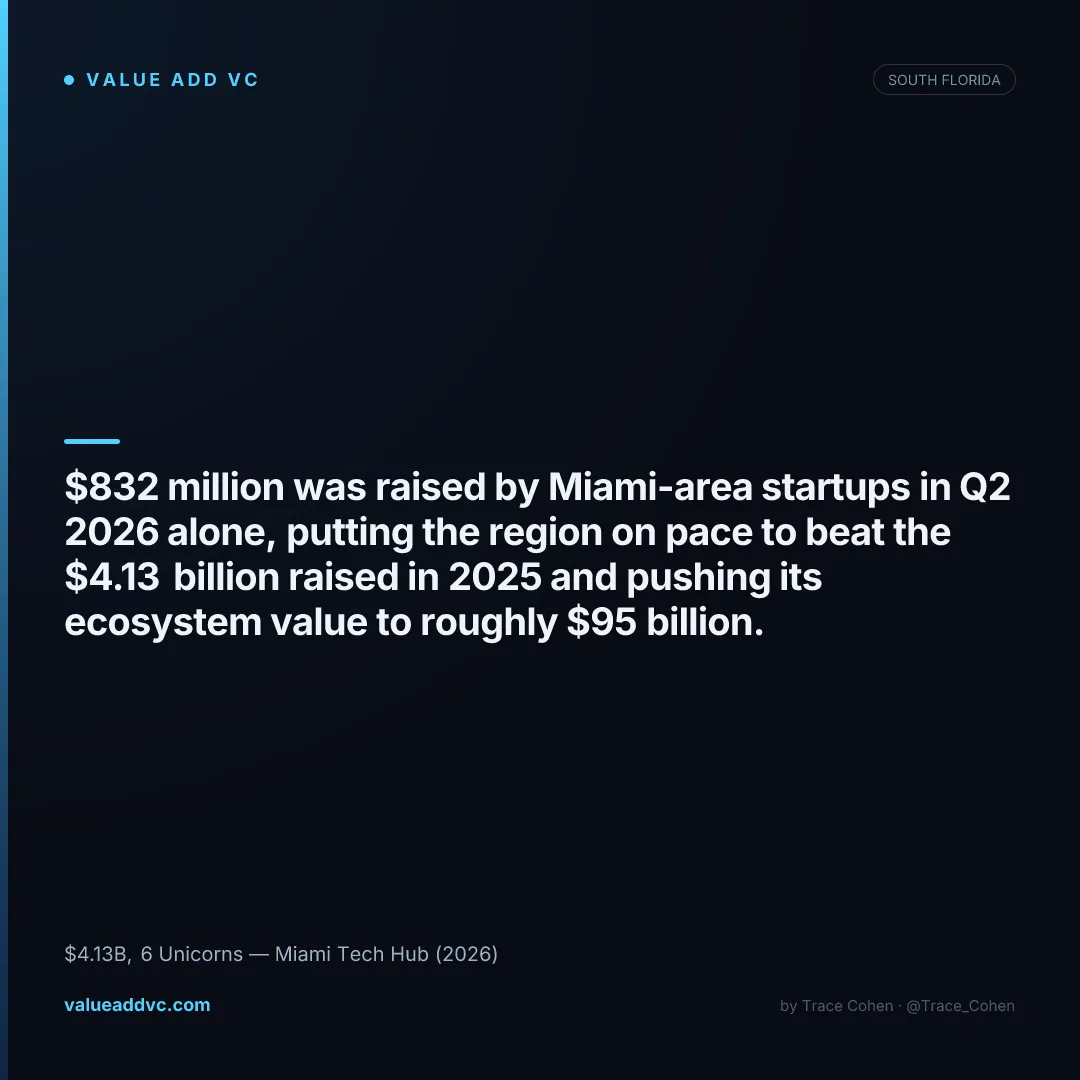
$832 million was raised by Miami-area startups in Q2 2026 alone, keeping the region on pace to beat the $4.13 billion South Florida raised in all of 2025. That's the short answer. The longer answer is that six unicorns, a $95 billion ecosystem valuation, and Palantir moving its global headquarters out of Denver are turning "Miami is the next tech hub" from a Twitter meme into a data point.
I've watched this migration up close for six years, first as a skeptic and now as someone who runs deal flow out of South Florida. The 2020-2021 wave was mostly hedge funds, crypto traders, and a handful of VCs testing out Zoom-era remote work. The 2026 wave looks structurally different — it's publicly traded companies moving their actual executive headquarters, and the funding data has finally caught up to the narrative.
Figures are 2024-2026 estimates blended from PitchBook (via Refresh Miami), Dealroom.co, and Startup Genome ecosystem rankings. VC figures cover the Miami-Fort Lauderdale metro unless noted as South Florida-wide.
Miami Tech Hub 2026: What the Data Actually Shows
Miami's tech hub status in 2026 is backed by three concrete data points: $832 million in venture funding raised by Miami-area startups in Q2 2026 alone (see the individually verified rounds on the South Florida funding tracker), a $95 billion total ecosystem valuation as of 2024 (up seven global ranks to 16th), and Palantir Technologies relocating its corporate headquarters from Denver, Colorado to the Miami area in February 2026 — the largest publicly traded company to do so.
None of those numbers alone would settle the "is Miami real" debate that's been running since 2021. Together, they describe a market that has moved from social-media hype and tax-driven personal relocations to actual capital deployment and corporate headquarters decisions — the two hardest things to fake in an economic development story.
The Companies Anchoring Miami's Tech Hub in 2026
Palantir Technologies announced in February 2026 that it moved its principal executive office from Denver to the Miami area, registering its new headquarters at 19505 Biscayne Boulevard in Aventura. It's the highest-profile headquarters move Miami has landed to date — a publicly traded, multi-billion-dollar enterprise AI and government-contracting company, not a startup chasing lower taxes.
Varonis, the data security firm previously headquartered in New York, relocated to Miami's Brickell Financial District in the same month and now occupies the entire 11th floor at 801 Brickell Avenue, housing its executive team and security research staff. Iru (formerly Kandji) is expanding its Miami footprint with plans to add more than 300 jobs by 2027.
On the capital side, SoftBank launched a dedicated Miami investment vehicle worth hundreds of millions of dollars, a16z has expanded its presence into the market, and Founders Fund is actively backing Miami-based fintech and AI startups. Local firms — TheVentureCity, eMerge Americas, and Rokk3r Labs — round out a bench that's grown from almost nothing in 2019 to a real regional investor base.
Miami's Biggest Startups, Ranked by Valuation
Miami startups guide 2026 rankings tend to lean on ecosystem-wide totals, but the individual companies matter more to founders deciding where to build. Below are the eight Miami-based companies with the largest disclosed valuations or funding totals as of mid-2026, ranked from largest to smallest.
Valuations and funding totals blended from PitchBook company profiles, Refresh Miami, CRE Daily, TechCrunch, and CB Insights deal data. Figures are the most recent publicly disclosed marks, which can lag actual current valuations by 1-2 years for private companies.
How We Ranked These Miami Startups
Ranking sorts strictly on the most recent disclosed valuation or, where no valuation is public, cumulative funding raised — pulled from company profiles on PitchBook and deal reporting from Refresh Miami. We only included companies with a verified Miami headquarters address, which excludes several LatAm-focused startups that maintain a Miami sales office but keep engineering and legal domicile elsewhere. Sponsorship and affiliate relationships never influence rank — see our editorial standards for how we source figures.
Miami vs. Other US Tech Hubs: Where It Actually Ranks in 2026
The most honest way to size up Miami's tech hub claim is against the cities it's most often compared to — Austin, NYC, and the Bay Area. Miami wins on momentum and growth rate; it still trails badly on absolute scale and unicorn density, though the region's billion-dollar companies are a growing list.
| Metric | Miami-Fort Lauderdale | Austin | NYC | Bay Area |
|---|---|---|---|---|
| US VC deal-count rank (2026) | #5 (tied) | #5 (tied) | #2 | #1 |
| US VC dollar-volume rank | #10 | #6 | #2 | #1 |
| Active unicorns | 6 | ~15 | ~120 | ~250+ |
| Ecosystem value (Startup Genome) | ~$95B | ~$130B | ~$900B | ~$3.5T+ |
| Global ecosystem rank (2024) | #16 | #20s | #2 | #1 |
| 2025 corporate HQ relocations (region) | 70+ (2020-2025 total) | Steady inbound | Net outbound | Net outbound |
| Dominant sector | Fintech / crypto / LatAm | Enterprise SaaS / hardware | Fintech / media | AI / enterprise software |
Figures are 2024-2026 estimates blended from PitchBook-NVCA Venture Monitor, Startup Genome Global Startup Ecosystem Report, Dealroom.co, and Axios Miami relocation tracking. Unicorn counts and ecosystem values are directional, not point-in-time exact.
Why This Miami Tech Hub Wave Looks Different From 2021
The first Miami migration, kicked off publicly by Mayor Francis Suarez's "how can I help" tweet in December 2020, was mostly individuals — hedge fund managers, crypto founders, and remote-first tech workers moving their households, not their companies. Funding followed briefly in 2021 ($3.4 billion, an artifact of the broader 2021 VC bubble) before falling back to $2.1-2.9 billion in 2022-2023 as the wider market corrected.
What changed by 2025-2026 is the type of relocation. A proposed California wealth tax on billionaires pushed more West Coast executives east in early 2026, but the companies following them are now publicly traded enterprise vendors — Palantir, quantum computing firms, cybersecurity leaders — bringing global executive headquarters rather than opening a satellite sales office. That's a structurally different signal than a founder moving to South Beach for the winter.
I'd put real weight on one detail specifically: Varonis taking an entire floor at 801 Brickell for its security research team, not just its sales staff. Sales offices are cheap to open and cheap to close. Research and engineering headcount is a multi-year commitment, and that's the category of relocation Miami has struggled to attract until this most recent wave.
What's Still Missing From Miami's Tech Hub Case
Six unicorns and a #16 global ecosystem ranking are genuine progress, but they're still a fraction of what NYC (roughly 120 unicorns) or the Bay Area (250+) can claim. Miami's $10 billion-range annual VC dollar volume puts it around 10th nationally — solidly top-tier, but nowhere near the scale where later-stage, capital-intensive companies (foundation-model labs, chip designers, biotech with 8-figure trial costs) can be built end-to-end locally without a Bay Area or Boston satellite.
The honest read: Miami has built a real, durable base in fintech, crypto, real estate tech, and LatAm-facing SaaS — categories where its bilingual talent pool and geography are genuine, structural advantages nobody else can copy. It has not yet built the deep bench of PhD-level AI research talent or biotech infrastructure that would let it compete directly with the Bay Area or Boston on the most capital-intensive categories. For live fund and portfolio data across markets like this, our VC performance dashboard tracks how regional funds are actually performing, not just how much they've raised.
Should Founders Actually Move to Miami in 2026?
My honest answer, after six years of watching founders make this decision both ways: it depends entirely on what you're building. If you're building fintech, a payments rail, a crypto product, or anything that touches Latin American markets, Miami in 2026 is arguably a better home base than the Bay Area — you're closer to your customers, closer to a genuinely deep bilingual talent pool, and closer to the capital that specializes in exactly your category (SoftBank's Miami fund, Founders Fund's LatAm fintech bets, and a growing set of local seed funds all skew toward this exact profile). One of the city's own fintechs just closed a nine-figure round on exactly that thesis, going from Wharton dorm room to a $1.4 billion valuation without leaving Miami.
If you're building a foundation-model lab, a chip company, or anything that needs a deep bench of PhD-level research talent on day one, the calculus is different. That talent still concentrates overwhelmingly in the Bay Area and, to a lesser degree, Boston and Seattle, and no amount of favorable tax policy changes that in the next 24 months. The founders I'd actually advise to move are the ones whose core moat is distribution, regulatory relationships, or a specific customer base — not the ones whose moat is a research team that doesn't exist locally yet.
For investors, the read is simpler: Miami has crossed the threshold from "interesting optionality" to "a real regional market with its own dealflow, its own local funds, and its own exit history," which is exactly what the unicorn data and funding trend above show. It's not yet a substitute for a Bay Area or NYC presence if you're writing checks across every sector, but it's no longer a market a generalist fund can afford to ignore entirely.
Bottom line: Miami's 2026 tech hub claim is no longer just a vibe — $832 million raised in a single quarter, a $95 billion ecosystem valuation, and Palantir relocating its actual headquarters from Denver are hard data points, not marketing. But six unicorns against NYC's 120-plus and the Bay Area's 250-plus is the honest scoreboard: Miami has won the fintech, crypto, and LatAm-corridor categories outright, and it still has real ground to cover before it's a peer to the largest US hubs across every vertical.
Latest from the Pulse
Get VC data most people never see
— 100% free
Weekly benchmarks, valuations, and fund data. Join 5,000+ investors. No spam.