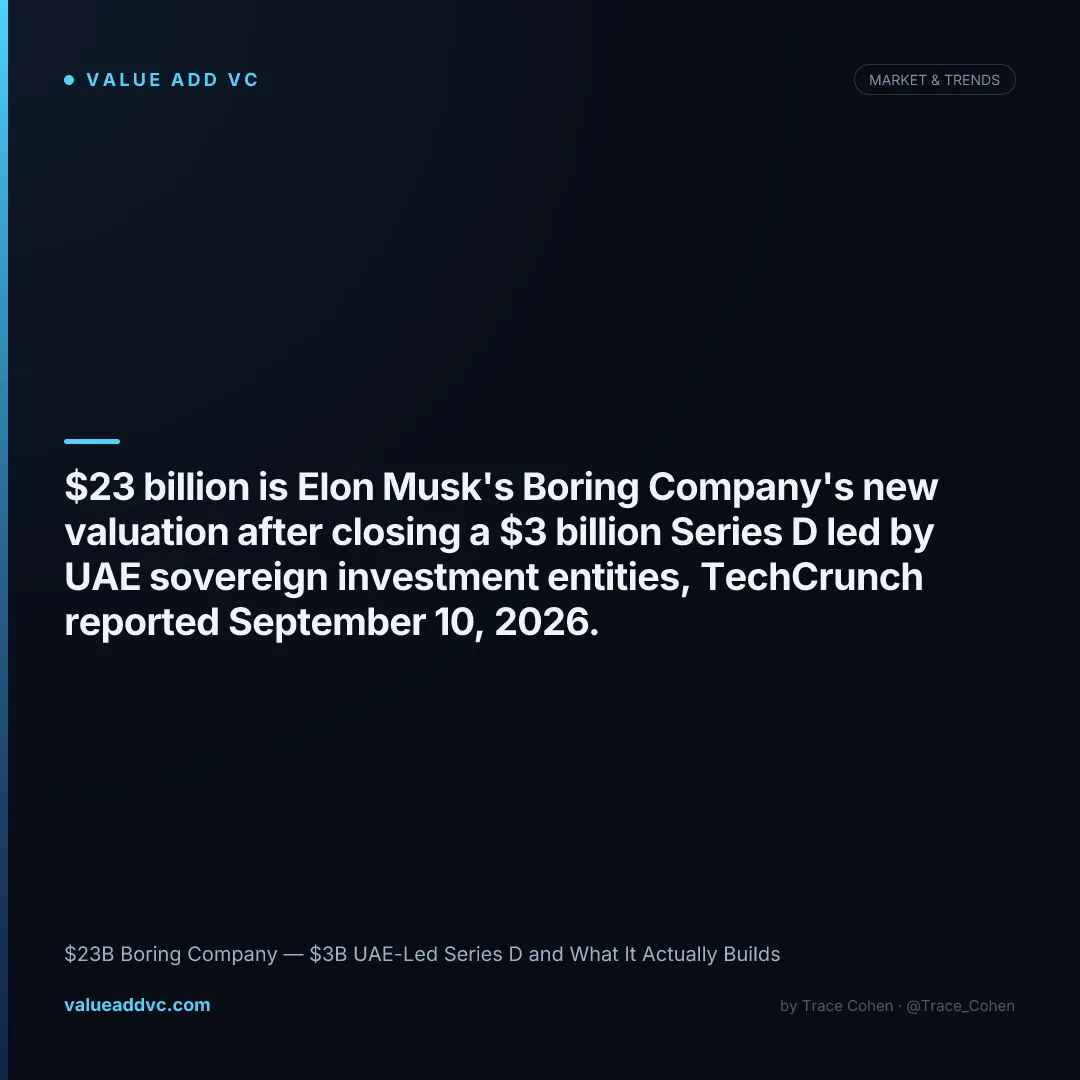
$23 billion is The Boring Company's new valuation after closing a $3 billion Series D led by UAE sovereign investment entities, TechCrunch reported on September 10, 2026 — roughly a fourfold increase from its $5.7 billion mark in 2022. The gap between that price and what the company has actually built is still the story.
Elon Musk's tunneling company has one commercial project to show for eight years of existence: the Vegas Loop, a network of tunnels under the Las Vegas Convention Center and Strip that now moves up to 26,000 passengers a day in modified Teslas. It has never disclosed profitability, its total lifetime funding before this round was under $1 billion, and Nevada regulators have cited it for nearly 800 environmental violations. None of that has stopped a sovereign buyer from committing $3 billion to fund more than 150 kilometers of new tunnels across the UAE.
The Boring Company Valuation in 2026: The $3B UAE-Led Series D
The Boring Company closed a $3 billion Series D round led by United Arab Emirates sovereign investment entities, valuing the company at $23 billion, TechCrunch reported September 10, 2026, with additional participation from Sequoia Capital, Andreessen Horowitz, Temasek, Valor Equity Partners, Vy Capital, Human Capital, Shamal Holding and Baron Capital. The new valuation marks roughly a fourfold increase from the $5.7 billion mark The Boring Company carried in 2022, Electrek reported — a re-rating pace that puts a tunneling infrastructure company in the same tier as the AI application startups that have dominated funding headlines this year, despite The Boring Company operating in a far less hyped, capital-intensive infrastructure sector. (An earlier July 2026 Wall Street Journal report had described talks for a separate $4 billion round at a $20 billion valuation; the UAE-led Series D that actually closed in September carries different terms and a different lead.)
Source: TechCrunch, Electrek, September 10, 2026.
Funding History: From $113M Seed to a $3B Series D
The Boring Company's fundraising has been unusually sparse for a company now valued at $23 billion. It raised roughly $113 million across a seed round and early rounds in 2018-2019, added $120 million in July 2019, and closed a $675 million Series C in April 2022 led by Vy Capital and Sequoia Capital, with Valor Equity Partners, Founders Fund, 8VC, Craft Ventures, and DFJ Growth also participating — several of the same names that back SpaceX and Tesla. That put lifetime funding at roughly $908 million before this year, according to Crunchbase's funding data on the company. The new $3 billion Series D is more than 3x everything the company raised in its first eight years combined.
What The Boring Company Has Actually Built
The company's flagship, and effectively only, revenue-generating project is the Vegas Loop, a system of tunnels beneath the Las Vegas Convention Center and, increasingly, the Strip. The original Convention Center segment opened in April 2021 with 1.7 miles of tunnel and three stations, built for a reported $47 million. Passengers ride in modified Tesla vehicles driven through the tunnels, with average ride times under two minutes and average wait times around 15 seconds. By 2026, ridership has scaled to as many as 26,000 rides on peak days, and the tunnel network has expanded well beyond the original convention-center footprint toward resort properties along the Strip.
Revenue comes from three sources: an operating fee the Las Vegas Convention and Visitors Authority pays the company, reported at around $167,000 a month; direct passenger fares; and licensing of the underlying tunneling technology to other venues and municipalities. None of those figures have been aggregated into a disclosed annual revenue number, which is precisely the gap between what's known and what a $23 billion valuation implies.
| Metric | Figure |
|---|---|
| Vegas Loop tunnel length (original segment) | 1.7 miles |
| Original build cost | $47M |
| Stations (original segment) | 3 |
| Opened to the public | April 2021 |
| Peak daily ridership, 2026 | ~26,000 rides/day |
| Average ride time | Under 2 minutes |
| Average wait time | ~15 seconds |
| Reported LVCVA operating fee | ~$167,000/month |
Figures blended from The Boring Company's public Vegas Loop materials, Inverse, Tesorb's Vegas Loop tracker, and Crunchbase News reporting, as of July 2026. Ridership and fee figures are drawn from operator and regulatory disclosures and may vary by reporting period.
How the Boring Company Valuation Compares to Musk's Other Companies
Even at $23 billion, The Boring Company remains by far the smallest of Elon Musk's active ventures — a rounding error next to SpaceX, which was valued near $350 billion before its 2026 IPO activity pushed the combined SpaceX-xAI entity toward a $1.49 trillion market cap as SPCX. Tesla's market cap has fluctuated in the hundreds of billions to over $1 trillion depending on the period. The investor list on the new Series D — Sequoia, Andreessen Horowitz and Valor Equity Partners each hold significant positions in SpaceX and, in some cases, xAI as well — reads like a roster of firms already deep into Musk's other companies, raising the cross-portfolio concentration questions LPs have flagged about Musk-adjacent venture bets generally.
The Case Against the $23B Number
The skepticism is straightforward: a $23 billion valuation on a company whose only fully operational commercial asset generates an operating fee in the low six figures a month implies investors are pricing in tunnel contracts and city expansions that haven't been proven at scale, not revenue that exists today. Nevada regulators said in 2025 that The Boring Company had violated environmental regulations nearly 800 times during tunnel construction, and worker injury reports have drawn additional scrutiny. Transit planners have also questioned whether a car-based tunnel system like the Vegas Loop or Dubai Loop can match the passenger-per-hour capacity of conventional subway or light-rail infrastructure at anywhere near a comparable cost — a skepticism the UAE round doesn't resolve, since Dubai's Loop is still early enough in its buildout that comprehensive ridership and reliability data isn't yet public.
The counterargument, which is presumably what's driving the UAE's commitment, is that The Boring Company is being priced less like an infrastructure operator and more like a platform company with one proven deployment and a pipeline of similar deals in other cities — the same logic that let xAI raise at escalating multiples well before Grok had meaningful revenue. Whether that logic holds for tunneling the way it has (so far) for frontier AI is the open question the $3 billion Series D is really testing. If Dubai's Loop underdelivers on ridership or reliability before more of the 150-kilometer UAE network is built, the $23 billion mark will look considerably harder to justify than it does today.
What the UAE Commitment Actually Requires
The $3 billion Series D is earmarked for more than 150 kilometers of underground tunnel infrastructure across the UAE, extending work already underway through the Dubai Loop project — a much larger, single-country commitment than the company's original US pitch of point-to-point tunnels meant to relieve urban traffic congestion in cities like Las Vegas and Los Angeles. The Boring Company has floated tunnel proposals in multiple U.S. cities over the years — including pitches around Fort Lauderdale, Los Angeles, and a Chicago-to-O'Hare concept — but none has advanced past early planning or has been shelved after local pushback over cost-sharing, safety oversight, or construction disruption. The UAE round reflects a 2026 pattern of Gulf sovereign wealth directing capital toward frontier infrastructure bets in exchange for exclusive regional buildout rights, the same dynamic that has funded large stakes in AI data-center capacity and defense manufacturing this year.
It's also worth separating two different products the company sells: the transportation-as-a-service model it runs in Las Vegas, where it owns and operates the tunnel and collects fares plus an operating fee, versus a tunneling-technology-and-construction model, where it's paid to build infrastructure for someone else to operate — which is closer to the model the UAE round is funding. The first is a small, high-margin, single-city business today. The second is the one that could theoretically justify a much larger valuation if it converts into a proven, multi-city network — but as of September 2026, Dubai's Loop is still early enough in its buildout that comprehensive ridership and reliability data isn't yet public.
How the Round Fits the Broader 2026 Private Funding Environment
The Boring Company's UAE-led round lands in a private market where 2026 Q1 alone saw roughly $300 billion in new global startup investment, heavily concentrated in AI infrastructure names like OpenAI, Anthropic, and xAI, each raising tens of billions of dollars at valuations that dwarf their current revenue multiples on any conventional basis. A fourfold valuation increase for a tunneling company puts it in the same re-rating tier as the AI application startups — Cognition, Harvey, Clay — that have dominated funding headlines this year, despite The Boring Company operating in a capital-intensive, physical-infrastructure category that historically commands far more conservative multiples than software. That doesn't make the valuation "right" in an absolute sense, but it does explain why investors accustomed to funding Musk's other ventures at steep multiples might not blink at 4x in four years for a company that, unlike most AI labs pricing pre-revenue research bets, already has paying riders and a functioning revenue line, however small.
The Bottom Line
The Boring Company closed a $3 billion Series D at a $23 billion valuation, up roughly 4x from $5.7 billion in 2022, led by UAE sovereign investment entities betting on a 150-kilometer tunnel commitment rather than the Vegas Loop's current economics. The company still hasn't published a revenue figure investors can underwrite independently of Musk's broader ecosystem or the UAE's own regional ambitions — which makes this round less a bet on the Vegas Loop's current economics and more a bet on whether Dubai's Loop is proof of a repeatable model across an entire country.
Track private valuations across the market on the Unicorn Tracker and AI-specific comps on the AI Valuations dashboard at Value Add VC.
Latest from the Pulse
Get VC data most people never see
— 100% free
Weekly benchmarks, valuations, and fund data. Join 5,000+ investors. No spam.