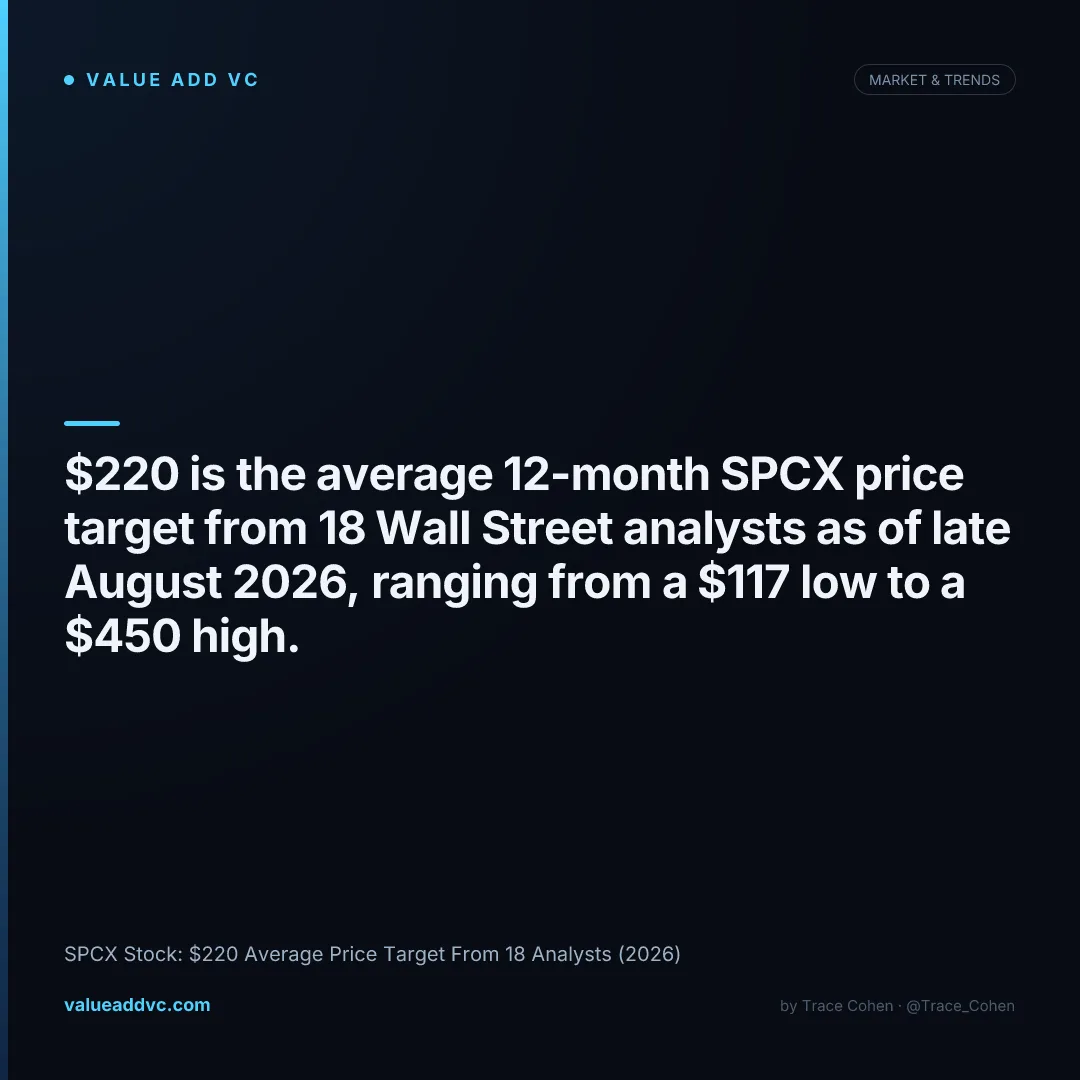
$220 is the average 12-month price target Wall Street has put on SpaceX (SPCX) as of late August 2026 — up from $164 two months ago, even though the stock itself trades below where it did right after its June IPO. The gap between the stock price and the average target opened up after SPCX's first lock-up expiration hit the tape on August 6 and the sell-off bears had priced in never showed up.
SpaceX went public on June 12, 2026 at $135 per share, raised roughly $10 billion, and traded near $161 within 48 hours. Since then the stock has been anything but calm: it slid to an all-time low of $108.27 on August 5, then rallied a cumulative 26% off that low once the market digested a wave of newly tradable insider shares without the feared crash, as we laid out when the listing was still just a signal to read. At roughly $141.50 today, SPCX carries a market capitalization of about $1.91 trillion.
Analyst Price Targets: The Spread Has Widened
Coverage has grown from 5 analysts at IPO to 18 today, and the range of opinion has widened rather than converged. The average 12-month price target now sits at $220, roughly 34% above where the stock trades.
High Target
$450
~218% upside from current price
Low Target
$117
~17% downside from current price
Average Target
$220
From 18 analysts covering SPCX
Consensus Rating
Buy
32 Buy, 7 Hold, 1 Sell (40 tracked ratings)
Recent target changes lean bullish overall, but the dispersion between individual firms is unusually wide for a stock this closely covered. Bank of America reiterated its Buy rating post-earnings with a $235 target, Bernstein raised its target from $239 to $248, and Morgan Stanley's Adam Jonas reiterated Buy with an unchanged $300 target, citing long-term upside from Starlink and Starship well into 2027. On the more cautious end, Wells Fargo's Ken Gawrelski cut his target from $230 to $215 while keeping a Buy rating, and Piper Sandler cut its target from $156 to $140 — below where the stock trades today — while downgrading to Neutral and citing the lock-up expiration, rising projected 2027 capex, and uncertainty around long-term AI-cloud demand for Starlink's ground infrastructure business. For the segment-level numbers behind those calls, including the Q2 2026 earnings print, see our SpaceX revenue and margin breakdown.
| Firm | Analyst | Rating | Price Target | Change |
|---|---|---|---|---|
| Morgan Stanley | Adam Jonas | Buy | $300 | Reiterated |
| Bernstein | — | Buy | $248 | Raised from $239 |
| Bank of America | — | Buy | $235 | Reiterated |
| Deutsche Bank | Edison Yu | Buy | $235 | Maintained |
| Wells Fargo | Ken Gawrelski | Buy | $215 | Cut from $230 |
| Wolfe Research | — | Outperform | $175 | Reiterated |
| Piper Sandler | — | Neutral | $140 | Cut from $156, downgraded |
Source: TipRanks, Deutsche Bank, Wells Fargo, Piper Sandler, and Wolfe Research analyst notes, August 2026.
The First Lock-Up Expiration: A Stress Test Wall Street Wasn't Expecting
The single biggest event in SPCX's short trading history so far wasn't an earnings report — it was the standard 90-day post-IPO lock-up rolling off on August 6, 2026. Roughly 911 million insider shares became eligible to trade that day, pushing the free float from about 639 million shares to roughly 1.55 billion shares almost overnight, according to CNN's coverage of the unlock.
Traders had priced in a supply-driven sell-off: the stock fell 14% the day before the unlock, touching an all-time low of $108.27. Instead, the flood of new shares was absorbed largely by institutions and passive index funds building positions at lower prices, and the stock reversed. It gained a cumulative 26% off that low, with a large chunk of the move — a single-day jump of 15.8% — tied to news of a $16.8 billion joint investment with Tesla in a Texas semiconductor facility called Terafab, unrelated to the lock-up itself but timed close enough to compound the reversal.
One read on this: the market treated the lock-up less as a supply shock and more as a liquidity event that let large, patient capital in at a discount. That is a bullish signal about demand, but it does not resolve the underlying question of whether the multiple is justified — it just changes who is holding the stock. Additional lock-up tranches are scheduled to unlock through 2027, and each one is a live test of whether this pattern repeats.
It also changed the shareholder base in a way that matters for volatility going forward. A free float that doubled overnight, absorbed mostly by institutions and index funds rather than retail traders, tends to dampen day-to-day swings compared to a thinly-floated stock — but it also means a larger pool of shares can move if sentiment turns, since institutional holders rebalance in size rather than trickling out a few shares at a time.
The Bull Case: Starlink + Launch Dominance
Bulls anchor their thesis on two pillars: Starlink and SpaceX's monopoly-like position in heavy-lift launch.
Starlink generated an estimated $11.8 billion in trailing-twelve-month revenue, growing at 80%+ year-over-year, and the satellite internet service now covers 100+ countries with over 7,000 active satellites in orbit. Analysts near the $450 high target argue Starlink alone could be worth $200+ billion as it scales into aviation, maritime, enterprise, and government contracts.
On the launch side, SpaceX completed 127 orbital missions in 2025, more than every other launch provider on Earth combined. The Falcon 9 booster has been reflown up to 25 times, pushing marginal launch costs toward an estimated $15 million per mission. Starship, the next-generation super-heavy vehicle, promises to cut that further and opens the door to NASA's Artemis lunar program, Mars missions, and point-to-point Earth transport.
A third pillar bulls point to is government revenue: Starshield, the military variant of Starlink, and SpaceX's existing NASA and Department of Defense launch contracts give the company a revenue base that is largely insulated from consumer spending cycles. That government book is also what analysts like Deutsche Bank's Edison Yu cite when defending a Buy rating even after the stock's volatile first ten weeks — contract revenue is lumpy but far stickier than subscription churn.
The Bear Case: Valuation, Governance, and Dilution
The lowest target on the Street, $117, implies roughly 17% downside from here — not a call that SpaceX is a bad company, but a call that the market has already priced in years of near-perfect execution.
Still a rich revenue multiple. At a ~$1.91T market cap on ~$13.6B trailing twelve-month revenue, SPCX trades at well over 100x revenue. Even the most premium SaaS companies rarely sustain multiples above 30x.
Concentrated voting control. Elon Musk retains supervoting shares that give him outsized voting power relative to his economic stake. Public shareholders have limited governance influence — a red flag for institutional investors focused on shareholder rights.
Share count is still expanding. The free float roughly doubled at the first lock-up alone, and more tranches unlock through 2027. Each one dilutes existing holders' relative influence even if it does not directly reduce economic value.
Capex intensity is rising, not falling. Piper Sandler's downgrade specifically flagged higher projected 2027 capital expenditure — Starship's production ramp, Starlink Gen2 satellite manufacturing, and the newly announced Terafab chip facility with Tesla all compete for the same capital, and none of them generate revenue on the same timeline as they consume cash.
What the Headline Misses
The narrative that the lock-up "passed without a crash" undersells how unusual the setup was: SPCX fell to an all-time low the day before the unlock, which means sellers who wanted out at a reasonable price had already been shaken out before the supply hit. That is a different outcome than a lock-up rolling off into a stock trading near its highs, and it is not obvious the pattern generalizes to the next unlock in 2027. The Tesla/SpaceX Terafab investment that coincided with the rebound is also a related-party transaction between two Musk-controlled companies, which adds return potential but also adds another layer of governance complexity for public shareholders to underwrite.
Key Metrics to Watch
Heading into the rest of 2026 and the next lock-up tranches in 2027, analysts have flagged several metrics that will drive the stock:
Starlink Subscriber Growth
Currently ~5M+ subscribers. Sustained growth toward 10M by end of 2027 would validate the bull case.
Future Lock-Up Tranches
More insider shares unlock through 2027 — each is a repeat test of whether demand absorbs new supply as it did in August.
Starship Milestones
Orbital success, booster reuse, and payload capacity demonstrations will unlock new revenue streams.
Path to a Lower Multiple
Revenue growth outpacing the share count expansion is what would bring the ~100x+ multiple down without the stock price falling.
How SPCX Stacks Up Against Other 2026 Debuts
SPCX's round trip — up 19% in two days, down to an all-time low, then up 26% off that low — looks tame next to some of 2026's other high-profile tech listings. AI chipmaker Cerebras (CBRS) traded as high as roughly $386 after its IPO before falling under $170 on a disappointing earnings report; it trades around $186.67 today. Microreactor startup Standard Nuclear (STDN) priced its IPO near $15 and has traded down roughly 35% at points since, sitting at about $13.94 today.
The common thread across all three: 2026's frontier-tech IPO class priced aggressively on growth narratives, and every one of them has since traded through a period of real doubt before the market re-established a level. SPCX is the only one of the three that has already worked through a scheduled lock-up expiration — the mechanical, calendar-driven test the other two still have ahead of them.
Bottom Line for Investors
Two and a half months into its life as a public company, SPCX has already been through an all-time low, a 26% rebound, and its first major supply test. The average analyst target of $220 and a Buy-leaning consensus (32 Buy, 7 Hold, 1 Sell) suggest Wall Street still believes Starlink's recurring revenue and SpaceX's launch monopoly justify a premium — even a lower one than at IPO.
But the spread between the $117 low target and the $450 high target is enormous for a company this size, and it reflects genuine disagreement about how to value a business growing this fast on a multiple this high, with a share count still expanding and one person controlling the vote. The August lock-up passing calmly is a data point in the bulls' favor, not proof the thesis is settled.
Track the latest SpaceX data on our SpaceX IPO Dashboard, and explore more analysis on the Value Add VC blog.
Latest from the Pulse
Get VC data most people never see
— 100% free
Weekly benchmarks, valuations, and fund data. Join 5,000+ investors. No spam.