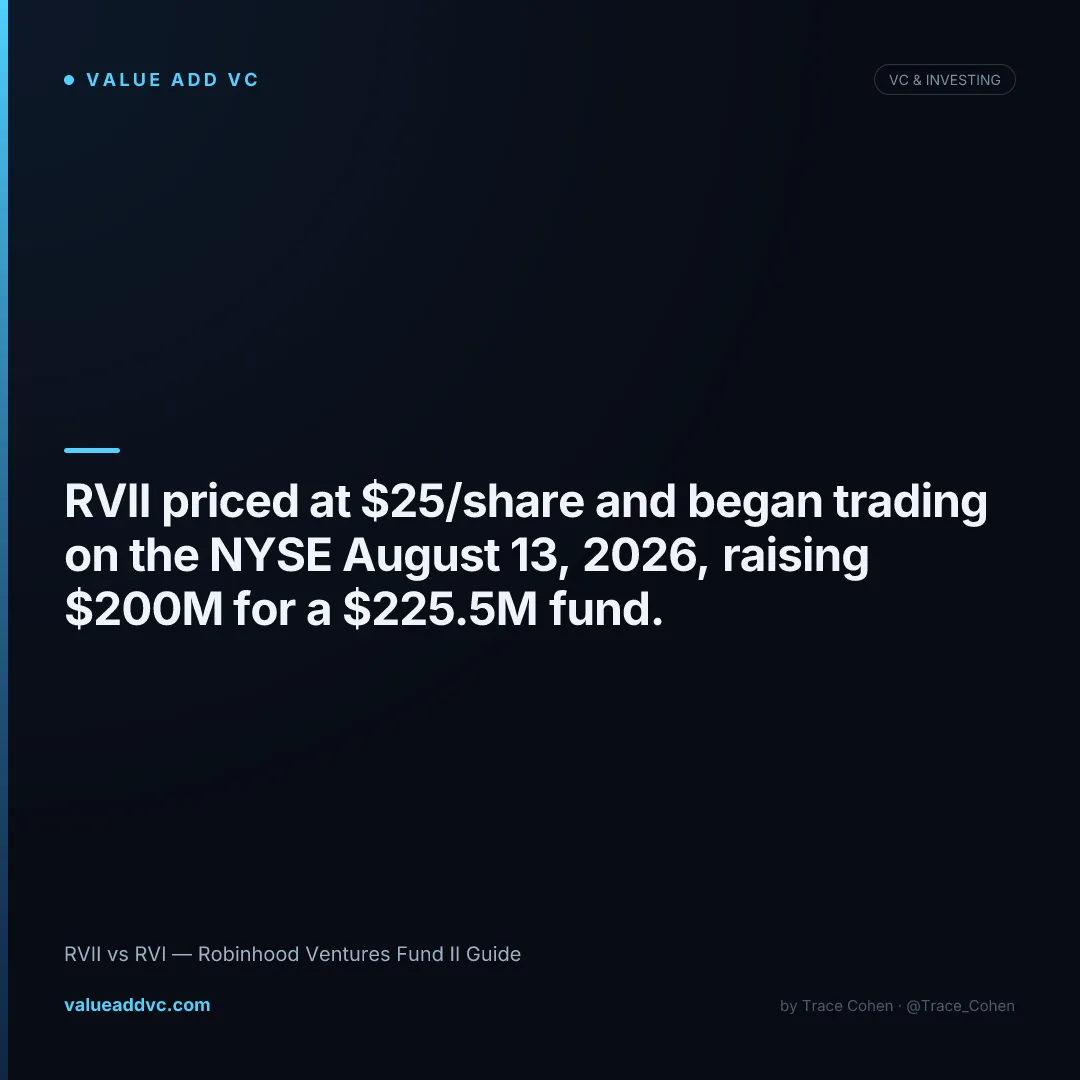
Robinhood Ventures Fund II — ticker RVII — priced at $25 a share and began trading on the NYSE on August 13, 2026, holding 80 Y Combinator-connected startups behind a 2-and-20 fee structure. It opened its first session at $22.50, a discount to that IPO price. We've already broken down all 80 companies, position by position, on our interactive RVII dashboard. What's still not disclosed matters just as much: no NAV, no distribution policy. This page tracks both columns — and it gets updated as details drop.
We've covered Robinhood's first venture fund since it listed in March — the holdings, the NAV math, and above all the premium that ran to ~90% and then collapsed. Fund II is a genuinely different product wearing the same wrapper, and the single most useful thing you can do before buying it is understand what happened to Fund I. That story is below, with real prices.
Figures from Robinhood's August 3, 2026 announcement and Form N-2 registration statement, as reported by GlobeNewswire, StreetInsider, and TechTimes.
What Is Robinhood Ventures Fund II?
RVII is a closed-end business development company registered under the Investment Company Act of 1940 — the same legal wrapper as RVI, and the only structure the SEC permits for a retail-accessible fund holding mostly illiquid private securities. Robinhood announced it August 3, 2026, filed a Form N-2 to offer 8 million common shares, and ran a share-request window for Robinhood Financial customers and TradePMR Fusion advisers that closed August 12 — one day before the NYSE debut. The IPO priced at $25/share on August 13, raising $200 million toward a $225.5 million total fund, and closed August 14.
The mandate is what makes it interesting: instead of chasing the biggest names in the late-stage private market, RVII invests in a diversified portfolio of 80 early-stage companies that are current or former Y Combinator participants, or whose founder or co-founder came through the accelerator. It's closer to buying a slice of YC's pipeline than to buying a stake in any single marquee company — and it reportedly layers leverage on top, amplifying whatever that basket does in both directions.
Confirmed Facts vs. What's Still Undisclosed
Here is every material fact about RVII, labeled honestly. "Confirmed" means it comes from Robinhood's announcement, the registration statement, or the completed IPO itself; "expected" means an estimate still pending actual reporting; "not disclosed" means exactly that — and we'll fill those rows in as the filings land.
| Detail | What We Know | Status |
|---|---|---|
| Ticker / exchange | RVII on the NYSE | Confirmed |
| First trading day | August 13, 2026 | Confirmed |
| IPO price / first-day open | $25.00/share priced; opened at $22.50 | Confirmed |
| Structure | Closed-end BDC (1940 Act) | Confirmed |
| Shares offered / fund size | 8M shares, $225.5M total fund | Confirmed |
| Mandate | 80 early-stage companies, 100% YC-connected | Confirmed |
| Largest position | Tasklet — 4.50% (only overweight) | Confirmed |
| Standard weight | ~1.12% each (78 of 80 companies) | Confirmed |
| Cash & equivalents | 7.39% (vs Fund I's 19.78%) | Confirmed |
| Top sector | Technology — 64.31% across 55 companies | Confirmed |
| Base management fee | 2.00% of net assets | Confirmed |
| Incentive fee | 20% of realized capital gains | Confirmed |
| Est. total annual expenses | ~4.18% (per TechTimes' N-2 review) | Expected |
| Leverage | Reportedly ~67% additional exposure on equity | Reported, unconfirmed |
| NAV at listing | — | Not disclosed |
| Distribution / dividend policy | — | Not disclosed |
Sources: Robinhood August 3, 2026 announcement (GlobeNewswire), StreetInsider, TechTimes review of the Form N-2, and our own filing analysis on the RVII dashboard. Rows marked "not disclosed" will be updated as filings publish.
What RVII Holds: 80 Companies, Near-Equal Weights, 100% YC
We went through the disclosed portfolio company by company — the full interactive breakdown of all 80 names, with descriptions, lives on our RVII dashboard. The headline findings: every single holding passes the YC filter (current YC company or YC-alum founder), and the weighting is almost mechanical. 78 of the 80 companies sit at a standard ~1.12% weight. The only overweight is Tasklet, a cloud agent OS, at 4.50%; the only underweight is Luel at 0.45%. Cash and equivalents are 7.39% — well below Fund I's 19.78% cash drag.
By sector, this is overwhelmingly a technology fund: 64.31% of the portfolio across 55 companies. Industrials (8.96%, including defense names like Tenet Industries' strike drones and Apollo Atomics' compact nuclear reactors) come second, then financial services (7.84%), healthcare (6.72%, including CellType's AI drug discovery), consumer cyclical, energy, and communications. The near-equal weighting is the tell for how to think about this fund: nobody is picking winners here. It's a systematic bet that YC's ~1.5% acceptance rate is itself the selection mechanism — a venture index fund on the accelerator's pipeline, not a portfolio manager's conviction list.
64.31%
Technology
55 companies
8.96%
Industrials
8 companies
7.84%
Financial Services
7 companies
6.72%
Healthcare
6 companies
7.39%
Cash
vs 19.78% in Fund I
2.24%
Consumer Cyclical
2 companies
1.12%
Energy
1 company
1.12%
Communications
1 company
How RVII Differs From RVI
Same wrapper, same $25 sticker, nearly opposite bet. RVI concentrated its book in a handful of late-stage names — Databricks, OpenAI and Stripe lead the June 30, 2026 disclosure — and SpaceX went public in 2026, converting part of the fund into a high-fee wrapper around increasingly buyable stocks. Since that disclosure, RVI's two largest named positions have both repriced higher in private markets: Databricks closed a $5B round at a $190B valuation on August 13, and OpenAI's private valuation moved to $852B after an August tender offer — developments RVI's disclosed weights don't yet reflect. RVII spreads capital across 80 companies that are years from any IPO, which changes almost every property of the investment:
Concentration → Diversification
A single SpaceX earnings surprise moves RVI's NAV materially. In RVII, no single startup is likely to matter much — you're betting on the YC pipeline's aggregate hit rate, not on any one company's outcome.
Late-stage → Early-stage
RVI's holdings were IPO-ready mega-caps with real secondary-market price discovery. RVII's early-stage positions get marked off far thinner data — meaning NAV is more of an estimate, and stays that way longer.
~2.5% → ~4.18% expenses
Identical 2% headline fee, but RVII adds a 20% incentive fee on realized gains plus a smaller expected asset base spreading fixed costs — pushing estimated total expenses to nearly double RVI's.
Scarcity thesis → Pipeline thesis
RVI's premium was built on scarcity: the only liquid way to own SpaceX and OpenAI. That thesis had an expiration date, and it expired. RVII's thesis — access to YC's deal flow — doesn't expire the same way, but it also lacks the marquee names that made retail chase RVI to $57.
For the deeper side-by-side — fee tables, share counts, stage focus — see our full RVII vs RVI breakdown and our Pulse deep-dive on the RVII IPO published when the fund was announced.
The RVI Lesson: A 90% Premium, Round-Tripped in Ten Weeks
If you read one section on this page before buying RVII, make it this one. RVI listed March 6, 2026 at $25.00 against a $24.70 NAV — essentially fair value, and has since traded above it, roughly 90%+ above the last reported NAV. Buyers at the top were paying almost $1.90 for every $1.00 of underlying private holdings, on the theory that being the only liquid path to SpaceX and OpenAI justified it.
Then the scarcity died on schedule. SpaceX listed on Nasdaq June 12 — and once the market could buy RVI's biggest holding directly, the premium unwound week after week: $35 by mid-June, $26 by mid-July, and $24.81 by the end of July, back below the March listing price. Anyone who bought the May peak was down more than 50% while the underlying portfolio was, if anything, worth more after its top holding's IPO. The bounce to $28.64 by August 12 came only after Robinhood announced RVII, and by August 27 it had settled back to $27.77 — a reminder that these funds trade on narrative as much as NAV.
The mechanism is structural, not a fluke. Closed-end funds have a fixed share count and no arbitrage keeping price near NAV, so the price is purely what the marginal retail buyer will pay. When enthusiasm exceeds float, you get 90% premiums; when the story fades, you get NAV or below — the median closed-end fund trades at a discount. We documented this dynamic in real time across the premium explainer, the premium/discount history, and the discount-history tracker. RVII inherits the exact same structure on day one.
Should You Wait for RVII or Buy RVI?
Honest answer: they're different enough that "which one" is the wrong frame — the real question is what exposure you actually want, and at what price relative to NAV.
RVI makes more sense if you:
- Want exposure to named, knowable companies — you can read exactly what it holds and check the marks yourself
- Prefer the cheaper fee load (~2.5% gross vs ~4.18% estimated for RVII)
- Can buy much closer to NAV than at the May peak — RVI traded around $27.77 in late August against a $24.70 NAV, a ~12% premium versus 90%+ at the top
- Accept that the remaining thesis shrinks as each holding goes public
RVII makes more sense if you:
- Want genuinely early-stage venture exposure — the kind retail has never had a listed wrapper for
- Believe in YC's aggregate pipeline more than in any single company
- Accept a heavier fee drag, reported leverage, and marks that are estimates for years
- Are disciplined enough to wait for the price to settle near NAV instead of chasing the open
And one rule applies to both: the premium you pay at entry matters more than the portfolio. RVI proved that NAV can rise while shareholders lose half their money, purely from premium compression. If RVII opens hot, the RVI chart above is what the other side of that trade looks like. Our five-question premium framework was written for RVI, but every question transfers directly to RVII — as does the step-by-step buying mechanics guide and the closed-end fund tax treatment.
The Complete RVI & RVII Coverage Library
We've tracked the Robinhood Ventures funds since Fund I listed. Everything below is kept current:
RVII is the broader, earlier, more expensive sequel to a fund whose defining event was a premium that appeared and vanished inside five months.
The confirmed facts fit in one table. The undisclosed ones — NAV, holdings, distributions — are what will actually determine whether $25 is a fair price. We'll update this page as each one lands.
This is a living page — last updated September 2, 2026, three weeks into RVII's NYSE trading. Track Fund I's NAV and premium on the Robinhood RVI Fund dashboard, and follow ongoing coverage on Value Add Pulse. Originally covered in the Trace Cohen newsletter.
Latest from the Pulse
Get VC data most people never see
— 100% free
Weekly benchmarks, valuations, and fund data. Join 5,000+ investors. No spam.