OpenAI is going public. The confidential S-1 landed on June 8, 2026 — and what happens next will define the AI era's relationship with public markets.
This is not a typical IPO. OpenAI converted from a nonprofit to a for-profit structure in 2025, has burned through tens of billions in compute costs, and carries a valuation that already exceeds most public companies on earth. Whether you are an institutional allocator, a secondary-market buyer, or simply tracking the AI sector, here is everything you need to know. Track all upcoming tech listings on the Tech IPO Dashboard.
The S-1 Filing: What We Know
On June 8, 2026, OpenAI confirmed it had submitted a confidential draft registration statement (S-1) to the U.S. Securities and Exchange Commission. The filing was made under the JOBS Act provision that allows Emerging Growth Companies to submit confidentially — though OpenAI's revenue far exceeds the EGC threshold, suggesting either a different confidential pathway or a waiver.
The company's statement was notably cautious: "it may be a while" before shares trade publicly. This language signals that OpenAI is using the confidential period to test SEC receptivity, finalize its corporate restructuring disclosures, and prepare for what will be an extraordinarily complex prospectus.
Key items the S-1 must address: the 2025 nonprofit-to-for-profit conversion, Microsoft's complex investment structure and revenue-sharing arrangements, ongoing litigation (New York Times copyright suit, Elon Musk's claims), compute commitment obligations ($10B+ in contracted GPU capacity), and the competitive dynamics disclosure around Anthropic and Google DeepMind.
IPO Timeline: When Will OpenAI Trade?
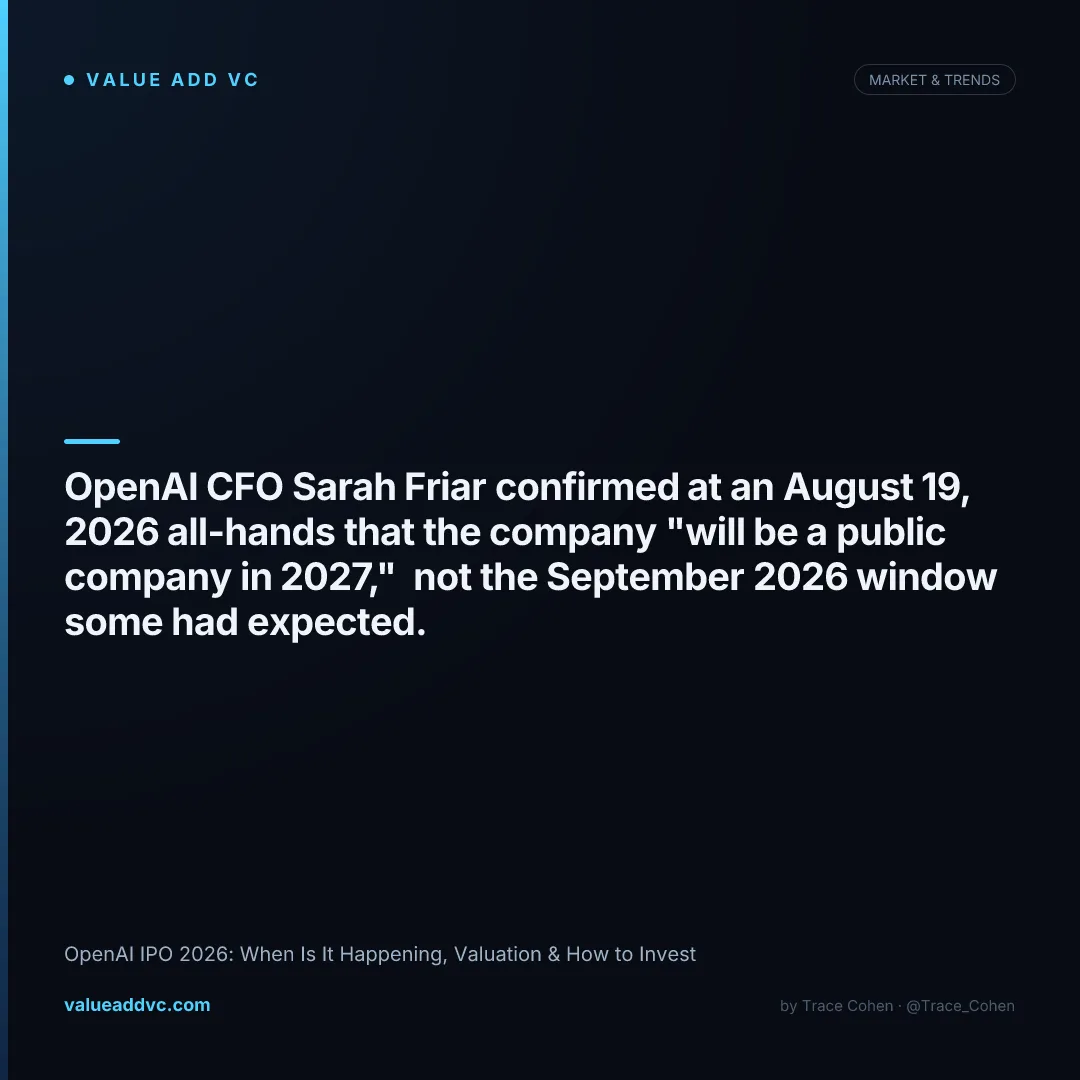
The timeline question that was speculative in June is now confirmed from the company itself. At an August 19, 2026 all-hands, CFO Sarah Friar told employees OpenAI "will be a public company in 2027," according to CNBC's reporting — while leaving the door open to going sooner "if our business continues to inflect." That officially closes the door on the aggressive September 2026 window some bankers had floated earlier in the year.
Confirmed: 2027
Friar's own words to staff, not a banker leak: 2027 is now the company's stated target. She framed the $122B raised in the March 2026 round as giving OpenAI "flexibility" on timing — a signal the company isn't under cash pressure to rush a listing.
Upside Case: Late 2026/Early 2027
Friar's caveat — sooner if the business "continues to inflect" — leaves room for an earlier print if growth accelerates further. She also downplayed any pressure to beat Anthropic to market, telling staff "we are running our own race."
The most likely scenario remains largely unchanged from OpenAI's own guidance: the S-1 becomes public sometime after the confidential review closes, a roadshow follows, and pricing lands in 2027 rather than the final months of 2026. The company will want to show at least two quarters of post-restructuring financials to establish a clean baseline for public market investors.
The August 2026 All-Hands: What Friar Told Employees
Beyond the timeline itself, Friar shared internal growth figures at the same all-hands that give the clearest public signal yet of OpenAI's trajectory heading into a 2027 listing:
Overall revenue run-rate
Up 35% quarter-over-quarter so far in Q3 2026, per Friar's comments to staff.
Enterprise revenue run-rate
Up 50% quarter-over-quarter — enterprise is growing faster than the consumer business, a data point IPO investors will weight heavily.
AI coding weekly active users
20 million weekly active users on OpenAI's coding and work-product tools, per the same briefing.
"The IPO is not a finish line"
Friar's own framing: an IPO is "a milestone, another fundraise" rather than an end state — consistent with a company in no rush to list before it's ready.
None of this is audited S-1 disclosure — it's guidance shared internally and reported secondhand — but a 35% quarterly revenue run-rate acceleration and 50% enterprise growth, if they hold up in the eventual filing, would support the bull case for a $1T+ valuation even with the 2027 timeline pushed out from earlier expectations.
Valuation: From $852B to $1T+
OpenAI's valuation trajectory has been extraordinary. Here is the progression:
$29B
Jan 2023
$86B
Jan 2024
$157B
Oct 2024
$852B
Mar 2026
At $852B, OpenAI is already valued higher than all but a handful of public companies globally. The IPO valuation could exceed $1 trillion — a 34x revenue multiple on $25B ARR. For context, Nvidia trades at roughly 30x forward revenue, and Microsoft at 12x.
The bull case for a $1T+ IPO rests on three pillars: AI market TAM expansion (projected $1.8T by 2030), OpenAI's dominant consumer brand (ChatGPT has 400M+ weekly active users), and enterprise adoption inflecting upward. The bear case: margins are thin, compute costs are rising, and competition is intensifying from Anthropic (valued at $965B) and Google DeepMind. Compare AI company valuations on the AI Valuations Tracker.
Revenue and Business Model
OpenAI's ~$25B ARR breaks down across several business lines (for the full revenue deep-dive, see OpenAI Revenue 2026: $20B ARR and the Path to Profitability):
ChatGPT Consumer (Plus/Pro)
200M+ subscribers at $20-$200/month
~$10B
Enterprise API
GPT-4/5 inference for developers and businesses
~$9B
ChatGPT Enterprise/Team
Business tier at $25-$60/seat/month
~$4B
Other (Sora, DALL-E, licensing)
Media generation, IP licensing deals
~$2B
Revenue growth has been remarkable — roughly 3x year-over-year since 2023. But profitability remains elusive. OpenAI's compute costs (primarily NVIDIA H100/B200 GPU clusters through Microsoft Azure) consume the majority of revenue. The company is estimated to spend $30B+ annually on infrastructure, talent, and research.
The path to profitability depends on inference cost reductions (cheaper models like GPT-4o-mini), higher-margin enterprise contracts, and eventually training cost amortization as models become more efficient. OpenAI has guided investors toward profitability by 2029.
How to Invest in OpenAI Before the IPO
For investors who want exposure before shares trade publicly, three secondary market platforms currently facilitate OpenAI share transactions. See our full breakdown of every route to OpenAI stock exposure, including minimums, fees, and the non-accredited option through RVI.
EquityZen
Min: $10,000
Largest selection of OpenAI blocks
Forge Global
Min: $25,000
Institutional-grade platform
Hiive
Min: $50,000
Real-time bid/ask pricing
Secondary market shares typically trade at a 10-30% premium to the last funding round price. At OpenAI's March 2026 valuation of $852B, secondary shares are likely pricing the company at $900B-$1.1T already — meaning buyers are paying IPO-level prices without IPO-level liquidity or disclosure.
Important caveats for secondary buyers: shares may be subject to company right-of-first-refusal (ROFR), transfer restrictions, and information asymmetry. You will not have access to the S-1 financials until the filing goes public. Additionally, OpenAI has historically restricted secondary sales — the March 2026 tender offer was one of the few company-sanctioned liquidity events.
Alternative exposure: Microsoft (MSFT) owns a significant economic interest in OpenAI through its $13B+ investment and revenue-sharing agreement. Buying MSFT gives indirect OpenAI exposure with full public-market liquidity and disclosure — though diluted across Microsoft's $3T+ market cap.
Key Risks for IPO Investors
The OpenAI IPO carries risks that are unusual even by tech IPO standards:
Valuation compression
At 34x revenue with no profitability, any growth deceleration could trigger significant multiple compression. Public markets are less forgiving than private rounds.
Compute cost dependency
OpenAI is essentially a massive GPU consumer. NVIDIA pricing power, chip supply constraints, or Azure capacity limitations directly threaten margins.
Competition intensifying
Anthropic ($965B valuation), Google DeepMind (Gemini), Meta (Llama open-source), and dozens of startups are eroding OpenAI’s technical moat. Model performance gaps are narrowing.
Litigation overhang
The New York Times copyright suit, Elon Musk’s breach-of-contract claims, and potential regulatory action from EU AI Act enforcement create material legal uncertainty.
Nonprofit conversion scrutiny
The 2025 conversion from nonprofit to for-profit is unprecedented at this scale. California AG review, potential challenges from original donors, and reputational risk remain unresolved.
Key-person dependency
CEO Sam Altman’s November 2023 firing and reinstatement demonstrated governance fragility. The S-1 will likely flag key-person risk prominently.
OpenAI vs. Anthropic: The AI IPO Race
OpenAI is not the only generative AI giant approaching public markets. Anthropic, founded by former OpenAI executives Dario and Daniela Amodei, is valued at $965B and widely expected to follow with its own IPO filing in 2026 or 2027.
| Metric | OpenAI | Anthropic |
|---|---|---|
| Valuation | ~$852B | ~$965B |
| ARR | ~$25B | ~$15B (est.) |
| Lead Investor | Microsoft ($13B+) | Amazon ($8B+) |
| Flagship Product | ChatGPT / GPT-5 | Claude / Claude Opus |
| Founded | 2015 | 2021 |
| S-1 Status | Filed (Jun 2026) | Not yet filed |
The two companies represent different bets: OpenAI prioritizes consumer reach and product breadth (ChatGPT, DALL-E, Sora, voice), while Anthropic emphasizes safety research, enterprise reliability, and developer tooling. For investors, the question is whether the AI market is winner-take-all (favoring OpenAI's scale) or winner-take-most (allowing both to build durable franchises). Compare both on the AI Valuations Tracker.
What Happens Next
The confidential S-1 filing starts a clock. Here is what investors should watch for in the coming months:
SEC comment letters
Jul-Sep 2026
Expect 2-3 rounds of SEC questions, particularly around the nonprofit conversion and Microsoft relationship.
S-1 made public
Q4 2026 (est.)
The filing becomes publicly visible at least 15 days before the roadshow begins. First full look at financials.
Underwriter selection finalized
Q4 2026
Goldman Sachs and Morgan Stanley are rumored leads. Watch for bookrunner announcements.
Roadshow
Q1 2027 (est.)
10-14 day institutional investor tour. 150-250 meetings to build the order book.
Pricing and first trade
Q1-Q2 2027 (est.)
Shares price the night before listing. Expect massive first-day demand and potential pop.
The OpenAI IPO will be the defining liquidity event of the AI era. Whether it prices at $1T or higher, it will set the benchmark for how public markets value artificial intelligence companies — and determine whether the current private market valuations across the sector are justified or inflated. Follow all IPO filings and timelines on the Tech IPO Dashboard.
Latest from the Pulse
Get VC data most people never see
— 100% free
Weekly benchmarks, valuations, and fund data. Join 5,000+ investors. No spam.