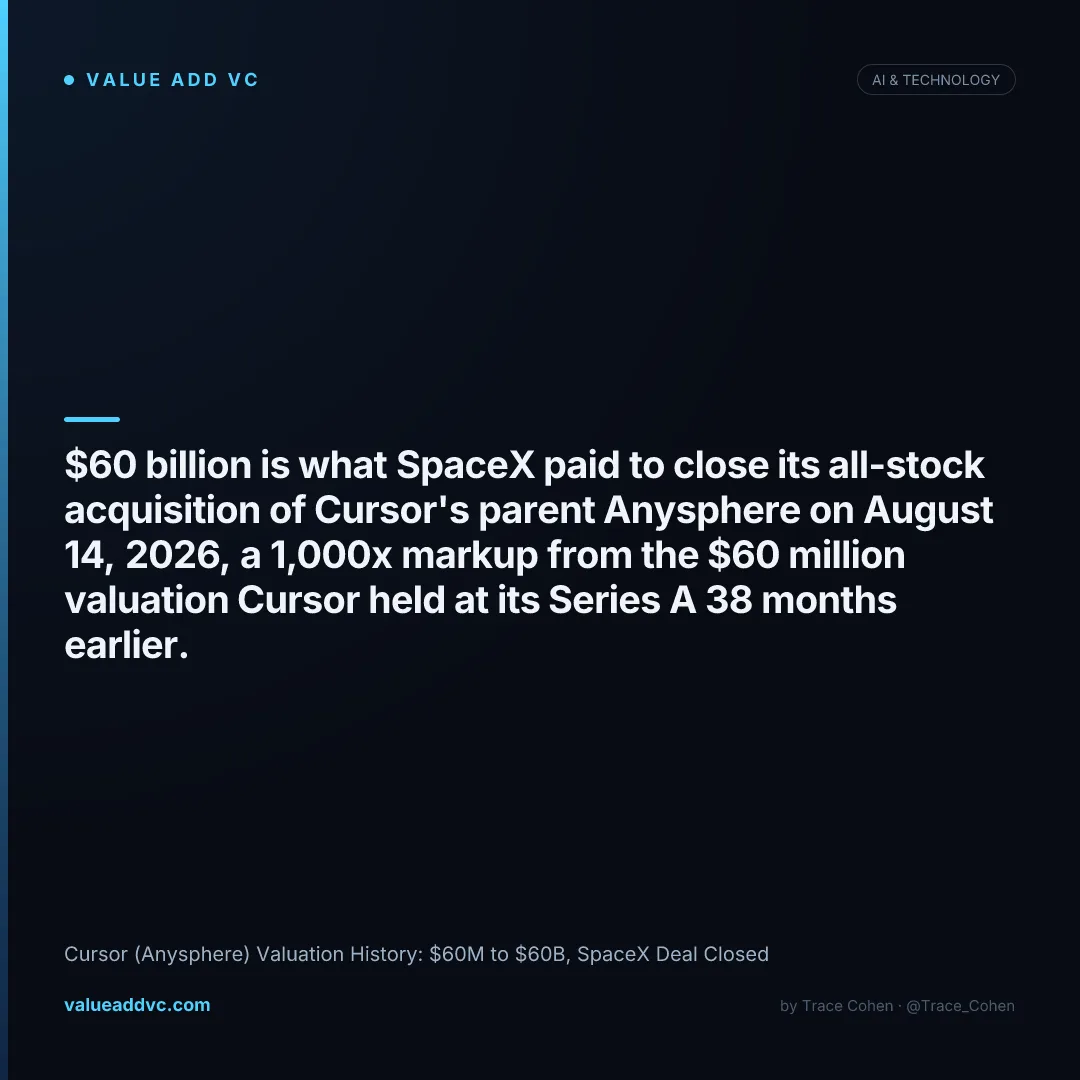
SpaceX closed its $60 billion all-stock acquisition of Cursor's parent company Anysphere on August 14, 2026 — a 1,000x markup from the roughly $60 million valuation Cursor held at its Series A just 38 months earlier, in April 2023. That's up from a $29.3B Series D in November 2025 and an April 2026 option agreement that first put the $60B price on the table.
The round-by-round math of how a free side project became a $60B SpaceX subsidiary in under 50 months explains a lot about how AI valuations actually got set in 2025 and 2026 — and what happens once the exit is done, not just promised.

Cursor AI Valuation and Funding: The Round-by-Round Math
Cursor's parent Anysphere raised approximately $3.4B across six priced equity rounds between 2022 and late 2025, with valuation climbing from ~$8M post-money at Y Combinator to $9.9B in 34 months and then $29.3B by November 2025, according to TechCrunch and TechFundingNews. A seventh round — $2B+ at a reported $50B valuation, co-led by Andreessen Horowitz and Thrive Capital with Nvidia as a strategic investor — was in talks as of April 17, 2026, per TechCrunch, but never priced: four days later, on April 21, 2026, Bloomberg reported that SpaceX had instead struck an option agreement giving it the right to acquire Cursor outright for $60B later in the year.
| Round | Date | Amount | Post-money | Lead investor |
|---|---|---|---|---|
| Pre-seed / YC | Aug 2022 | ~$0.5M | ~$8M | Y Combinator (S22) |
| Series A | Apr 2023 | $11M | ~$60M | OpenAI Startup Fund |
| Series A-2 | Aug 2024 | $60M | $400M | Andreessen Horowitz |
| Series B | Dec 2024 | $105M | $2.6B | Thrive Capital |
| Series C | Jun 2025 | $900M | $9.9B | Thrive Capital |
| Series D | Nov 2025 | $2.3B | $29.3B | Accel + Coatue |
| Series E (never closed) | Apr 2026 | $2B+ (reported) | $50B (reported) | a16z + Thrive (Nvidia strategic) |
| SpaceX option agreement | Apr 21, 2026 | n/a | $60B or $10B walk-away | SpaceX (Bloomberg) |
| Acquisition signed | Jun 16, 2026 | All-stock | $60.0B | SpaceX (merger sub X67 Inc.) |
| Acquisition closed | Aug 14, 2026 | ~391M SpaceX shares | $60.0B | SpaceX / SpaceXAI |
Mark-up math: $60M → $60B is a clean 1,000x step-up across 38 months (Series A close to signing). The Series C-to-D jump alone was ~3x in five months, and the SpaceX deal roughly doubled the November 2025 mark again in seven. Sources: TechCrunch, Bloomberg.
What Happened After the Deal Was Signed: The Close, the Shares, and SpaceXAI
The deal SpaceX signed on June 16, 2026 wasn't the end of the story — it took another two months to actually close. On August 14, 2026, per SpaceX's SEC Form 8-K, Anysphere's stock converted into 389,289,254 SpaceX Class A shares (plus 1,752,426 shares for vested RSUs), with SpaceX assuming roughly 29.1 million unvested RSUs and 44.4 million options from Anysphere's cap table — an all-stock structure with no cash component. Cursor now operates as a wholly owned subsidiary inside a newly rebranded SpaceXAI division, gaining direct access to SpaceX's Colossus supercomputer (reported at roughly 200,000 Nvidia GPUs, scaling toward one million) that already trains xAI's Grok models. For the full mechanics of the closing and what SpaceXAI does with the team, see SpaceX Closes $60B Cursor Deal.
This closes the loop that had been open since the November 2025 Series D: on June 16, 2026 — days after SpaceX's IPO — SpaceX exercised its option to acquire Anysphere, folding Cursor into the xAI-linked SpaceXAI subsidiary to anchor an enterprise AI-coding push against OpenAI and Anthropic. See the AI Valuations dashboard for the live comp set.
How Cursor's ARR Reached $4B Faster Than Any Other SaaS
Cursor crossed $100M ARR in January 2025, roughly 21 months after the IDE launched in March 2023. That broke the previous record held by Wiz (18 months from $1M to $100M ARR) for application-layer SaaS, per TechCrunch — and the ramp kept compounding: $500M by June 2025 (confirmed in Cursor's own Series C announcement), $1B by November 2025, $2B by February 2026, $3B by late April 2026, and past $4B annualized by early June 2026, with roughly 75% of that run-rate ($2.6B) coming from enterprise and B2B contracts, per Dealroom. The growth shape is unusual: bottoms-up developer adoption that converted to team and enterprise contracts inside large customers without a traditional outbound sales motion.
ARR Aug 2024
~$48M
ARR Jan 2025
$100M
ARR Jun 2025
$500M
ARR Nov 2025
$1B
ARR Feb 2026
$2B
ARR Apr 2026
$3B
ARR Jun 2026 (at signing)
$4B+
Enterprise share of ARR
~75%
Time to $100M ARR
~21 months
Who Founded Cursor and Why MIT Matters
Anysphere was founded in 2022 by four MIT undergraduates: Michael Truell (CEO), Sualeh Asif (CTO), Aman Sanger, and Arvid Lunnemark. The company went through Y Combinator's S22 batch and shipped Cursor publicly in March 2023, three months after ChatGPT's GPT-3.5 launch made code-completion-as-a-product viable in a way Copilot hadn't yet shown at scale. Truell was 21 when he raised the Series A; by the time the SpaceX deal closed in August 2026 he was 24 and had taken a company from a dorm-room project to a $60 billion acquisition in under four years — one of the fastest founder-to-exit timelines in software history, per the funding and deal dates cited above.
Michael Truell
Co-founder & CEO
MIT, computer science. Lead architect of the agent stack.
Sualeh Asif
Co-founder & CTO
MIT, computer science. Owns the inference and infrastructure layer.
Aman Sanger
Co-founder
MIT, computer science. Focus on model training and customization.
Arvid Lunnemark
Co-founder
MIT, computer science. Product and IDE engineering lead.
Cursor AI Valuation in Context: How It Compared to GitHub Copilot and Windsurf
At $29.3B post-money on roughly $1B ARR, Cursor's November 2025 Series D priced at ~29x trailing ARR — high by historical SaaS standards (5-15x) but in line with frontier AI infrastructure pricing in 2025-2026, a multiple the $4B+ ARR run-rate by June 2026 had already grown into well before SpaceX's $60B offer arrived. Compared to direct competitors, Cursor sat between Microsoft-bundled distribution (Copilot) and venture-funded standalone independents (Windsurf/Codeium, Replit, Sourcegraph). The full competitive layout as of the acquisition:
| Tool | Valuation | ARR | Pricing | Distribution |
|---|---|---|---|---|
| Cursor (Anysphere) | $60B (SpaceX, closed Aug 2026) | $4B+ (Jun 2026) | $20 Pro / $40 Biz | Direct, bottoms-up |
| GitHub Copilot | Part of Microsoft | $500M-$700M est. (2025) | $10-$39 | Microsoft 365 bundle |
| Windsurf (Codeium) | $1.25B → Google licensing deal | ~$40-$50M | $15 Pro | Direct, freemium |
| Replit | $1.16B | ~$40M+ | $25 Core / $40 Teams | Browser-native |
| Sourcegraph (Cody) | $2.6B (2022 peak) | Undisclosed | $9 Pro / Enterprise | Enterprise direct |
| Tabnine | ~$300M | Undisclosed | $12 Pro | Direct + IDE plugins |
Note: Windsurf agreed to a Google licensing deal in mid-2025 after a proposed $3B OpenAI acquisition collapsed, materially changing competitive dynamics in the second half of 2025. See AI Valuations Dashboard for the live valuation table.
Cursor's Customer Base and Why Enterprises Paid For It
Cursor's customer list reads like a who's-who of AI-native and post-2020 enterprise software: Stripe, Shopify, Instacart, OpenAI, Perplexity, Mercedes-Benz, Samsung, Johnson & Johnson, US Foods, and reportedly more than half of the Fortune 500 in some form of paid usage. The pricing model was simple heading into the acquisition: $20/seat/month for Pro, $40/seat/month for Business, and custom enterprise tiers above 100 seats with SSO and audit logging. Cursor never disclosed seat count directly, but a $4B+ run rate at blended per-seat pricing implies a paid base in the millions of seats globally.
Hobby (Free)
$0
2,000 completions/month, 50 slow GPT-4 requests
Pro
$20/mo
Unlimited Cursor Tab + 500 fast premium requests
Business
$40/seat/mo
Pro + privacy mode, admin dashboard, SAML SSO
Enterprise
Custom
Business + audit logs, dedicated support, custom contract terms
Why Cursor's Valuation Math Held Up Long Enough to Get Bought
Three things made Cursor's $29.3B Series D price defensible before the SpaceX deal even arrived — not the multiple itself, which was rich, but the underlying revenue shape that made it worth pricing that way at all:
What worked in Cursor's favor
- ✓ Real paid usage (not free trial vanity), Fortune 500 logos on monthly invoicing
- ✓ Subscription model with measurable seat expansion month-over-month
- ✓ 21 months to $100M ARR — fastest in SaaS history for an application-layer product, per TechCrunch
- ✓ Bottoms-up adoption inside customers like Stripe, OpenAI, Shopify meant low CAC
- ✓ Founders retained meaningful equity through the Series C and D
What the headline misses
- ✕ Gross margin was structurally 30-50%, not 80%+, because of inference cost
- ✕ Anthropic and OpenAI controlled the underlying model layer Cursor depended on
- ✕ Microsoft could bundle Copilot for free into 365, compressing the seat market
- ✕ VS Code itself could ship the same features natively (and had been doing so)
- ✕ The $60B all-stock price paid in SpaceX (Nasdaq: SPCX) shares, not cash — a bet Cursor's cap table is now making on SpaceX's own stock holding its value
What the Anysphere Rounds Tell Us About AI Valuations in 2025-2026
Cursor's $29.3B Series D on roughly $1B ARR — a ~29x trailing multiple — became the implicit benchmark for AI infrastructure companies shipping product to developers; Lovable, Replit, Bolt, and Codeium all repriced against the Cursor comp in the months after. That's how a single round resets a category. The same dynamic applies to the broader AI application layer: when investors see usage-based revenue compounding 10-20% monthly with real enterprise logos on it, they will pay 30-40x trailing ARR. Without those signals, multiples collapse fast — see the 2022 SaaS reset.
The question this post asked as of its original June 2026 publication — whether the $29.3B price, let alone the reported $50B+, would survive the next 24 months — has a clearer answer now: it didn't have to survive on its own, because SpaceX bought the company outright for $60B in an all-stock deal that closed August 14, 2026. That outcome sidesteps rather than resolves the underlying bet: whether Cursor's ARR growth holds above 8% monthly, whether it extends product surface area beyond the IDE into agents, terminal, and CI, and whether gross margin climbs from ~40% toward 60%+ as inference economics improve — those questions now belong to SpaceX's balance sheet instead of Anysphere's next funding round.
The bet SpaceX made at $60B wasn't that Cursor is the best AI code editor today.
It's that the IDE itself becomes an agent platform — and Cursor now owns that developer relationship inside SpaceXAI, alongside Grok.
Track AI funding rounds and valuations on the AI Valuations Dashboard and the broader AI Landscape at Value Add VC. Originally published in the Trace Cohen newsletter.
Latest from the Pulse
Get VC data most people never see
— 100% free
Weekly benchmarks, valuations, and fund data. Join 5,000+ investors. No spam.