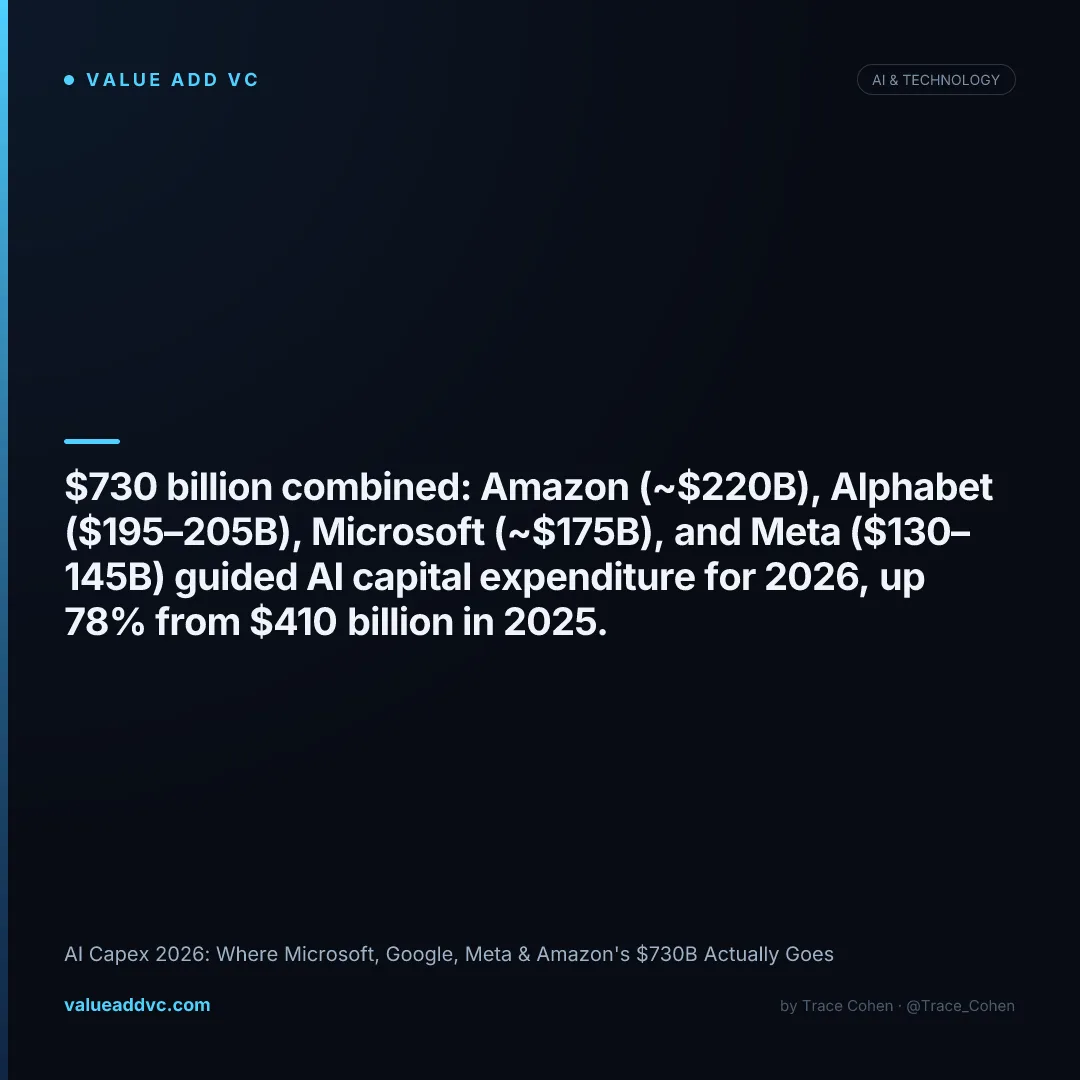
Big Tech AI Capex 2026: The Numbers by Company
| Company | 2025 Capex | 2026 Capex (Guided) | YoY Change |
|---|---|---|---|
| Amazon | ~$100B | ~$220B | ~+120% |
| Microsoft | ~$95B | ~$175B | ~+84% |
| Alphabet (Google) | ~$85B | $195–205B | ~+135% |
| Meta | ~$70B | $130–145B | ~+97% |
| Combined | ~$410B | ~$730B | +78% |
Sources: Company earnings reports and investor guidance (e.g. Microsoft's FY26 Q4 earnings call, CNBC's coverage of Alphabet's Q2 2026 capex raise, and Fortune's reporting on Amazon's $220B guide). Amazon and Microsoft figures are total company capex. Microsoft's 2026 figure reflects a useful-life accounting change (see below) rather than a smaller build. 2026 figures are the latest full-year guidance as of September 2026, all reaffirmed or raised on Q2 2026 earnings calls; quarterly actuals are tracked on the dashboards linked below. Goldman Sachs projects combined capex nearing $1.14 trillion in 2027.
Amazon (~$220B), Alphabet ($195–205B), Meta ($130–145B), and Microsoft (~$175B) are committing a combined ~$730B to AI infrastructure in 2026 — up 78% from ~$410B in 2025, a buildout scale with no real precedent in enterprise technology spending — and Goldman Sachs projects the combined number nearing $1.14 trillion in 2027.
This is not defensive spending or R&D hedging. Every dollar is tied to a specific bet: that AI compute will be the scarce resource that determines who wins cloud, enterprise software, and consumer products for the next decade.
What Each Company Is Actually Buying
Microsoft (~$175B)
- →GPU clusters powering Azure OpenAI Service — running GPT-4, o3, and next-gen models at enterprise scale (see our full Microsoft AI capex breakdown)
- →Global data center expansion: 100+ new facilities announced across US, Europe, Middle East, and Asia
- →Custom silicon research (MAIA chips) to reduce Nvidia dependency and lower per-token inference cost
- →Copilot infrastructure: every Microsoft 365 user generating AI requests requires dedicated inference capacity
Alphabet ($195–205B)
- →TPU v5 and v6 clusters — Google's custom AI accelerators now power Gemini and Google Cloud AI services (see our Alphabet $205B capex deep dive)
- →Search AI integration: Google must serve AI Overviews at query scale without margin collapse
- →Waymo compute: autonomous vehicle training requires continuous large-scale simulation workloads
- →DeepMind research infrastructure for AlphaFold successors and scientific AI programs
Meta ($130–145B)
- →MTIA (Meta Training and Inference Accelerator) — proprietary chip to eventually replace Nvidia GPUs for ranking and recommendations (see our Meta $145B capex breakdown)
- →Llama training runs: each Llama generation required clusters of 100,000+ H100s; Llama 5 will require more
- →Meta AI assistant infrastructure: serving 3B+ users across WhatsApp, Instagram, and Facebook
- →Reality Labs compute: VR/AR environments require real-time AI rendering at device edge
Amazon (~$220B)
- →AWS data center expansion to serve Bedrock (enterprise AI), SageMaker, and direct GPU rental (P5 instances)
- →Trainium2 and Inferentia chips — Amazon's custom silicon now handles significant internal ML workloads
- →Alexa+ rebuild: Amazon is rebuilding Alexa on a foundation model stack requiring substantial inference capacity
- →Anthropic partnership infrastructure: AWS is Anthropic's primary training cloud, requiring dedicated capacity commitments
Where the Money Actually Goes: Five Spend Categories
Most coverage frames hyperscaler capex as "buying Nvidia GPUs." That is accurate but incomplete. A typical AI infrastructure build breaks down across five categories:
GPU Clusters (40–50% of spend)
Nvidia H100, H200, and Blackwell GB200 NVL systems. At ~$30K–$40K per H100 and $60K–$70K per GB200, even modest cluster sizes cost billions.
Data Center Construction (25–35%)
New builds in Virginia, Texas, Iowa, and internationally. Google is building or expanding in 12 countries. Meta broke ground on a 2GW+ facility in Louisiana. Lead times for purpose-built AI data centers now run 18–24 months.
Networking Infrastructure (10–15%)
InfiniBand and high-speed Ethernet to connect GPU clusters at scale. Nvidia's networking division (formerly Mellanox) is a major beneficiary, alongside Arista Networks and Juniper.
Power & Cooling (10–15%)
A single modern GPU cluster consuming 100MW+ needs purpose-built power delivery and cooling. Companies are signing direct power purchase agreements with utilities and nuclear operators — Microsoft signed a deal to restart Three Mile Island.
Custom Silicon Development (5–10%)
Google's TPUs, Amazon's Trainium2, Meta's MTIA, and Microsoft's MAIA reduce Nvidia dependence over time. These are multi-year bets costing $2–5B per generation but pay off at hyperscaler scale.
Why the Microsoft, Google, Meta, Amazon AI Capex Race Keeps Escalating
Three structural forces prevent any company from pulling back unilaterally:
Training cost scaling
Each frontier model generation requires 10–100x more compute than the last. Skipping a training cycle means falling behind on capabilities that are now core to product differentiation.
Inference demand explosion
Deployed AI products — Copilot, Gemini, Meta AI — generate billions of queries per day. Inference at this scale requires more compute than training. Under-provisioning means slower responses and higher per-query costs.
Custom silicon race
Every company paying Nvidia $30,000–$40,000 per H100 is motivated to develop proprietary chips. But building silicon takes 3–5 years and billions in R&D — so capex now buys strategic independence later.
Nvidia Is the Real Beneficiary — For Now
Nvidia's data center revenue grew from $15B in FY2023 to $115B in FY2025 — largely on the back of hyperscaler capex (see our Nvidia valuation analysis). The most recent print, for fiscal Q2 2027 (the quarter ended July 26, 2026), shows data center revenue of $89.0B — up 117% year-over-year — as Nvidia's own results release (also filed with the SEC as an 8-K exhibit) credits the ramp of Blackwell Ultra systems, with the four major hyperscalers accounting for an estimated 40–50% of total GPU purchases.
But every dollar Microsoft spends on MAIA, Meta spends on MTIA, Google spends on TPUs, and Amazon spends on Trainium is a dollar that will eventually stop flowing to Nvidia. The custom silicon programs are 3–5 year bets, not current-quarter disruptions. For now, Nvidia captures the capex cycle. The question is whether its moat survives the transition to proprietary silicon at scale. It's also worth asking how much of Meta's own top line is actually attributable to AI versus the core ad business it's layered on top of.
Track the real-time data on our Big Tech Earnings Dashboard and AI Spending Tracker.
The Second-Order Effects Nobody Talks About
When four companies simultaneously ramp capex by 30–60% in a single year, the ripple effects extend well beyond the AI industry:
Power Grid Stress
The US electric grid was not designed for 100MW+ data center clusters. Dominion Energy has 30GW of data center capacity in the queue in northern Virginia alone — more than the state's entire current generating capacity. Big tech is now signing deals with <a href='/blog/nuclear-power-and-ai-why-big-tech-is-signing-deals-with-uranium-producers' class='text-[#00d4ff] hover:underline'>nuclear power providers</a> to secure supply.
Real Estate Markets
Data center REITs Equinix and Digital Realty have seen demand outpace supply in every major market. Land adjacent to power substations in rural Virginia, Iowa, and Texas has appreciated 300–500% since 2023. See our deep dive on <a href='/blog/ai-data-center-real-estate-the-geography-of-where-ai-infrastructure-is-being-built' class='text-[#00d4ff] hover:underline'>AI data center real estate</a>.
Construction Labor
Hyperscaler data center builds are competing with semiconductor fab construction (TSMC Arizona, Intel Ohio) and clean energy projects for the same pool of specialized electrical engineers and construction workers.
Inference Cost Compression
As GPU supply scales, inference costs continue to fall — the cost to run GPT-4 class inference dropped approximately 95% between 2023 and 2025. This is deflationary for AI infrastructure startups but highly beneficial for application-layer companies.
What This Means for Startups Building on AI
Tailwinds
- ✓ API costs continue falling as hyperscalers over-provision capacity
- ✓ More capable foundation models available at every price point
- ✓ Hyperscalers incentivized to court AI startups as platform anchors
- ✓ Enterprise buyers getting comfortable with AI procurement cycles
Headwinds
- ✕ Hyperscalers building native AI features into core products (vertical integration threat)
- ✕ Commodity AI becoming a checkbox feature, not a moat
- ✕ Enterprise buyers defaulting to hyperscaler AI to simplify procurement
- ✕ Custom silicon reduces third-party GPU availability during training windows
Five Signals That Would Mark the Cycle Peak
The race is self-reinforcing — each company fears falling behind if it blinks while the others accelerate. A plateau is more likely than a crash, and these are the signals to watch:
GPU lead times normalize from 12+ months to under 6 months — indicating supply has caught up to demand
Any of the four companies guides capex down year-over-year for the first time since 2022
Enterprise AI adoption metrics (daily active AI users per Fortune 500) plateau below model provider revenue projections
Nvidia's data center revenue growth decelerates below 20% year-over-year for two consecutive quarters
Power purchase agreement prices in key markets decline, signaling a data center build slowdown
None of these signals are flashing as of September 2026: GPU lead times remain elevated, all four companies reaffirmed or raised guidance on their Q2 2026 earnings calls in late July 2026, and enterprise AI adoption is accelerating across financial services, healthcare, and software development. The signal now worth watching instead is financing, not demand — see below.
What's New Since August 2026: Capex Is Starting to Outrun Cash Flow
The headline capex numbers above were all reaffirmed or raised in late July 2026, but the more consequential shift since this post was last checked, on August 20, 2026, is how that spending is being funded. Alphabet's $44.92 billion in Q2 2026 capital expenditure exceeded its $39.07 billion in operating cash flow, pushing quarterly free cash flow to negative $5.86 billion — the first negative quarter the company has disclosed since Google went public in 2004, according to Goldman Sachs' analysis reported by Yahoo Finance in September 2026.
That same Goldman Sachs research, published in September 2026, projects hyperscalers will fund more than a third of their roughly $1.14 trillion in 2027 capital expenditure with investment-grade bond issuance — up from about 26% of capex in 2025 and roughly 33% through the first half of 2026 alone. Separately, The Motley Fool reported on September 6, 2026 that S&P Global's own model puts six major hyperscalers at a combined $1.3 trillion in 2027 capex, with only one of the six projected to still generate positive free cash flow that year.
This likely means the AI capex race is entering a second phase: the constraint is shifting from "can these companies afford to build" to "how much of the build gets financed with debt rather than cash." That is a meaningfully different risk profile for anyone modeling hyperscaler balance sheets into 2027 — and a reason Alphabet's stock still fell after beating Q2 2026 estimates, per CNBC's coverage of the earnings reaction.
$410B in 2025. ~$730B in 2026. ~$1.14T in 2027.
The startups that win are not competing with this spending. They are making it more productive.
Explore Related Dashboards
Interactive tools with live data on this topic
Track hyperscaler earnings and AI infrastructure trends on the Big Tech Earnings Dashboard and the AI Chip Wars Dashboard at Value Add VC. See also: Big Tech Earnings Q1 2026 Results. Originally published in the Trace Cohen newsletter.
Latest from the Pulse
Get VC data most people never see
— 100% free
Weekly benchmarks, valuations, and fund data. Join 5,000+ investors. No spam.